
Part1
GoDeeper® is a Tocnology3's methodology, innovative technologies, and flexible (applicable and scalable) solutions for managing water resources and risks (such as floods, droughts, pollution, and salinity) in many regions around the world threatened by climate change and rising sea levels. Perhaps the Dutch case is considered one of the most important and complex of these cases, as follows:
While Tocnology3 recommends that countries worldwide to pump water from the sea to land (for desalination or other purposes) at a rate of 1-100 million cubic meters per day to combat climate change (and rising sea levels), the Dutch stands as the opposite case, It requires the drainage of a massive surplus of fresh water to the sea, averaging 250 million cubic meters daily, in a battle that can only be described as difficult, complex, costly, and ongoing. This raises the question: Do we really need to continue this battle and drain this enormous amount of fresh water? For the answer, read carefully to the end.
The Dutch lands (a large part of which, up to 60%, is low-lying and below sea level) are surrounded by three huge masses of water as follows:
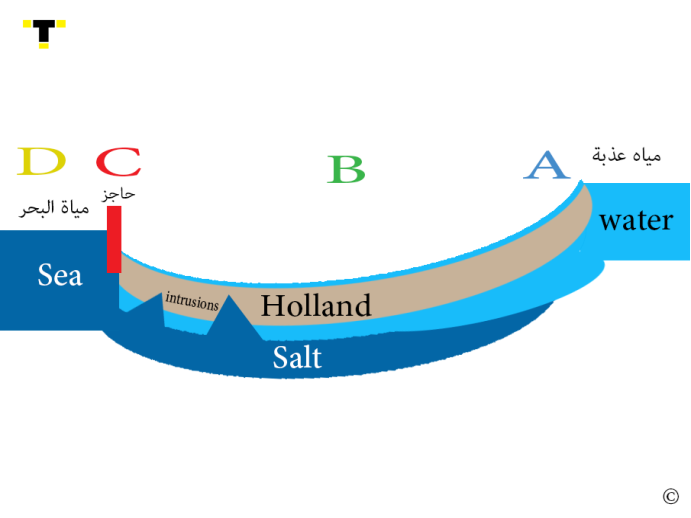
- Freshwater Mass (right):
From which flows a complex network of rivers and canals that end in the sea, the most important of which is the Rhine River, the largest supplier, as it alone carries about 70% of the total water that enters and leaves the Netherlands. The Meuse River contributes a smaller but vital percentage, and its flow speed is affected by rainfall in Belgium and France. The Scheldt River Flows into the southwestern regions.
-Saline Water Mass (Left):
Represented by the vast and elevated surrounding seas, separated from the land by mostly artificial structures such as dams and storm drains, which constitute a major line of defense in the battle.
-Fresh-Saline Water Mass (Middle):
Considered the true battleground, it is represented by surface water and the enormous underground basin, estimated at approximately 8200 km³, capable of holding about 2900 km³ of water. It is divided into the inner basin (blue) A, which represents about 30% of the total basin, with fresh water comprising 93% and saline water 7% (showing the predominance of fresh water over saline water). This reflects the absence of undesirable phenomena such as saline water intrusion in the blue upper areas (A). The outer basin (green) B, which represents 70% of the basin, with fresh water comprising about 41% and saline water about 59%. (And in it appears the advance of salt water over fresh water), which explains the appearance of some undesirable phenomena such as the formation of small or isolated water lenses or the appearance of salt water intrusions.
To clarify further, the flow from freshwater to saltwater (the sea) occurs in two pathways: one above ground (representing by surface water) and the other deep underground (representing by groundwater). In reality, this transfer does not occur naturally, as in most countries where rivers flow into the sea naturally. However, in the Netherlands (due to low land and high sea levels), auxiliary drainage systems are often employed. The available resources (both natural and artificial) include the following:
- Drainage Channels: A complex network that mostly includes natural structures such as riverbeds, elevated channels, and historical canals that ensure normal gravity flow.
- Pumping Stations: Widespread and often used to lift water to higher channels or discharge it into the sea.
- Protection and Defense Measures: These include sophisticated and unusual structures such as barriers, dams, sea storm surges, and sea gates (which are the first of their kind globally).
- Storage Media: These include vast underground and surface basins, represented by a group of reservoirs, the most important of them are Lakes IJsselmeer and Markermeer (which be considered as kidneys of the Dutch water management and drainage system). We will discuss here how their role can be improved, or even how can they be dispensed with (by reclamation).
The methodology of GoDeeper relies simply on deepening surface waterways and water bodies as far down as possible (naturally or artificially) to increase their freshwater capacity and role against saltwater( which has a higher density 1025 kg/m³) that can be deduced from the Gibben-Herzberg principle (where every meter of freshwater above sea level corresponds to approximately 40 meters of freshwater below sea level before reaching saltwater). Alternatively, the pressure can be calculated using the following hydrostatic equation:

In general, the pressure difference increases with depth and the hydrostatic gradient, ranging from 1 to 10 atmospheres, which represents a relatively small number. This difference is easily overcome by the proposed dynamic and hydrostatic pumping (compressing) technologies, which are capable of achieving high pressures and significantly increasing the freshwater-to-saline ratio. The solution also includes the ABCD division into four zones, as shown in the following figure:
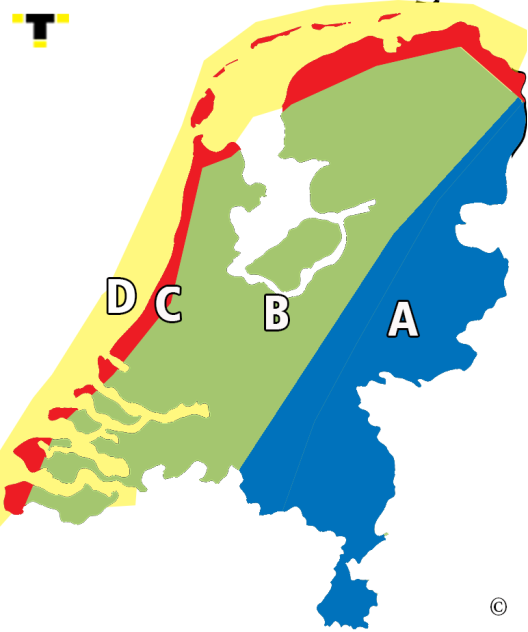
- Zone A (Blue) Advance: This zone represents areas where water flows and rivers enter from neighboring countries. These areas are characterized by their relatively high topography compared to other zones. Many believe that this zone is merely transit zone and play no role in the solution, but this is incorrect and represent an important starting point for a solution that may, in some cases, require initiating work even from neighboring countries (if possible). This involves achieving deep drainage (natural or artificial) for existing watercourses and bodies, or even creating ground and surface water barriers such as dams (if possible) in this zone (which is characterized by its relatively high elevation and distance from the effects of saltwater). This will increase its role in capacity C, head H, and flow Q of freshwater into the ground aquifer, which will have a significant and direct impact on other areas and on water resource management in general. With emphasizing the importance of eliminating or treating sources of pollution (if any exist and with help of Tocnology3).
- Zone B (Green) Below: This represents the lowest areas, which include reclaimed lands or what are called polders. These areas contribute to the solution through innovative APWS® Auto Polder Water Management Systems, which we will talk about later.
- Zone C (Red) Concrete: This represents the surrounding coastal zone, which contains massive and effective defensive structures. These structures play a crucial role in the solution and in the success of any future solutions.
- Zone D (yellow) Defense: This represents the coastal areas, which play a role in deploying innovative technologies described as offensive, supporting existing defenses, as we will see later.
Tocnology3 plays a role in what is called the artificial solution (an aid or alternative to the natural one) through new/innovative systems (flows) that include:
Auto Flow System:
In this system, water is discharged automatically (without using of electricity), New energy sources and technologies such as innovative hydrostatic ground compressors play a crucial role. It is a strong candidate for a larger drainage role in future of water resource management systems, as it can achieve high drainage rates of up to 1000 m³/s at pressures up to 1000 bar or even more.
Non-auto flow system:
In this system, water is drainage using electrically powered pumping (Compressors) technologies, such as innovative, highly efficient Modern Water Screw (MWS) pump (Compressor) capable of integrating renewable energy sources like wind power. This system is a strong candidate for high-volume, rapid drainage, as well as for defensive and offensive flows, as we will see later.
Clean flow system:
In it, water is purified and impurities and other pollutants (chemical or biological) are removed, with innovative and intensive direct filtration, treatment and desalination systems such as Desalination3 System can play an important role.
Triple (deep) flow system:
Drainage is no longer simply about lifting water upwards, but rather it must go deeper downwards and forwards as follows:
- Downward (charging): Here, hydrostatic ground compressors play a role in this deep pumping to increase the Head and piezometry of the groundwater, which represents a mechanism to increase the capacity of the groundwater reservoirs that can be recovered later and to increase the deep groundwater flow and drainage towards the sea.
- Upwards (discharging): where the water is lifted to higher levels or channels, and here we can go deeper by making this lifting automatic without consuming energy.
- Forward (push): Forward (horizontal) drainage is considered as it increases the flow Q velocity, and is also used in building defense and offense systems as we will see later.
Tocnology3 goes further here, as it can build multi-drainage systems. For example, an automatic compressor system can be built that charges (stores) water deep and at the same time lifts the excess upwards for surface drainage.
Open Flow System (Auto Polder Water System® APWS):
As we mentioned, polders are low-lying reclaimed lands that are often below sea level and characterized by their peaty soil, and fragile and sensitive water system, which makes them vulnerable to many hazards such as flooding, salinity, drought, and others.
Tocnology3 through GoDeeper offers a new and innovative automated water management system called Auto Polder Water System® (APWS), as follows:
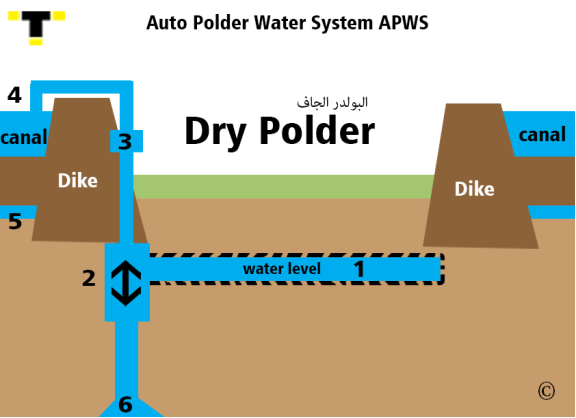
1- Leveling network: A network of perforated pipes that are deployed at a specific level (depth) underground (dry polder) or above ground (wet polder) and regulate the water level by discharging it to an innovative auto ground compressor.
2- Auto ground compressor: It discharges water in two directions, deep downwards (charging) or by raising the excess upwards (discharging) to the upper drainage channels. It can achieve a water drainage ranging from 0.1-100 m3/s depending on its size.
3- Control: This regulates the flow direction for water discharge or storage.
4- Upper Channel: This is where the flow is discharged.
5- Lower Channel (Optional): Also called the perimeter protection channel.
6- Lower Cavity Chamber (Optional): An innovative Technology that provides a larger area for higher groundwater infiltration at a lower pressure.
How it works:
Here's how the APWS system works and how it protects the polder from flooding, salinity, and drought (water shortage):
The system performs continuous and automatic drainage (without electricity) downwards and upwards, with a high drainage capacity (Q) and pressure (P), thus controlling the water level and getting rid of the polder (excess water) and protecting it from flooding, while at the same time it works to store excess water at the bottom (the underground polder reservoir) which can be retrieved when needed.
In case of problems such as salinity, the system will get rid of it by discharging it in only one direction downwards, where it is expelled deep by the flow of pure water later according to the principle of density difference.
In case of problems such as drought or water shortage, the system is able to easily provide water from the various sources it has acquired, such as its own underground reservoir, the pressurized surface flow, or the free surface flow (higher channels) where water can flow backward to the polder using a gravity (auto) water siphon system.
System Features:
- Automated water resource management (without human intervention).
- Self-operating system (no electricity required).
- Achieving high drainage (surface-underground).
- Minimal maintenance requirements.
- Supports both dry and wet polder concepts.
- Safe and fast means of groundwater recharge (without pollution).
- A safe and fast way to harvest and save (precious) rainwater.
- Can be discreetly deployed underground, occupying minimal land area.
- Protects the polder system from major problems such as flooding, salinity, and drought (water scarcity).
- Self-cleaning capabilities to prevent blockages in groundwater filtration.
- Contributing to achieving the concept of deep, large-scale auto-management of water resources (and controlling the general water level).
Closed-flow system (reliable and rapid transport):
An alternative or auxiliary drainage system for existing high and open drainage channels and rivers, constructed as closed pipes, either above or below ground. It achieves the concept of rapid transport (through a source-to-target pumping system).
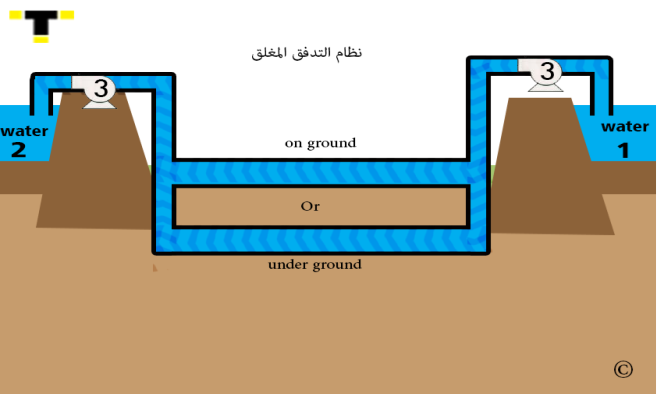
One of its most important applications is an innovative system called Fast River System® FRS (system of Managing runoff) in which a pipe with a diameter of between 0.5m–1.5m or even larger is deployed in the riverbed and divided by pumps such as the submersible of modern screw pump MWS, at specific intervals. This system achieves a fast and safe water drainage for the river at the bottom that assistant to the natural gravitational flow at the top, as follows:
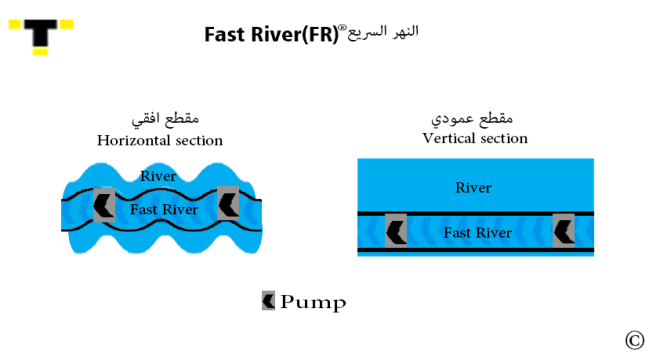
The pumps integrated within the pipe perform the tasks of passing the flow and achieving high differential pressure (vacuum from the front and compress to the back) towards the next pump, which performs the same tasks, thus achieving a fast and deep flow. The system also achieves the following features:
- It represents an integrated (hidden) solution.
- It allows for river water level control.
- It achieves safe and rapid river flow.
- It reduces the risk of rising river levels (river flooding).
- It reduces the risk of increased river velocity (by absorbing it).
- It provides a solution in narrow areas where river widening is not possible.
- It ensures continuous water drainage, whether the system (pumps) is operating or not.
- achieving high efficiency in operation and maintenance*.
*where, Fast River System can be built according to an innovative concept called Remote Flow Management® RFM, where pump system is divided into two parts: static equipment at the bottom of the river (which does not require maintenance at all) and dynamic + electrical equipment (which represents the driving force and can be maintained) outside of the river, thus achieving high efficiency in operation and maintenance.
Surface flow system (Rain and kidneys drainage):
Surface flow includes rainwater, rivers, canals and water bodies of varying sizes, perhaps the most important of which are Lakes Isselmeer and Markermeer (which we consider to be the kidneys of Holland drainage). From a technical point of view, there are two future scenarios related to them: increasing their performance (naturally and/or artificially) as a better option, or the option of dispensing with one or both of them (by reclamation as new polders) as a secondary option.
Option 1: Despite their shallow depth of 2-5 meters, the two lakes represent a significant water reservoir, estimated to hold approximately 8 billion cubic meters of water. The option of naturally deepening the lakes to depths of up to 40 meters would greatly enhance their performance and increase their freshwater reserves. However, this solution appears to be highly controversial within Dutch engineering circles due to the associated risks. These risks include the potential intrusion of salinity resulting from the removal of the heavy clay layer (a natural seal) at the bottom of the lakes, the potential structural instability of surrounding embankments that may not withstand the deepening, the risk to the ecological balance of the lakes, the high financial cost of removing the layers and deepening them, and the potential social and tourism (recreational) risks associated with this solution. Therefore, this option is now considered unlikely.
Tocnology3 proposes an artificial solution as an alternative and safe solution (without compromising the current structure of the lakes) with greater results, including increasing the storage volume in the lakes to great depths of up to 300m to take advantage of the underground reservoir and convert it into a huge freshwater reservoir that may have a capacity of up to 150 billion cubic meters of fresh water, to contribute significantly to solving the problems of flooding (by increasing deep drainage capacity), salinity and drought (by increasing ground storage and tipping the balance in favor of fresh water), as follows:
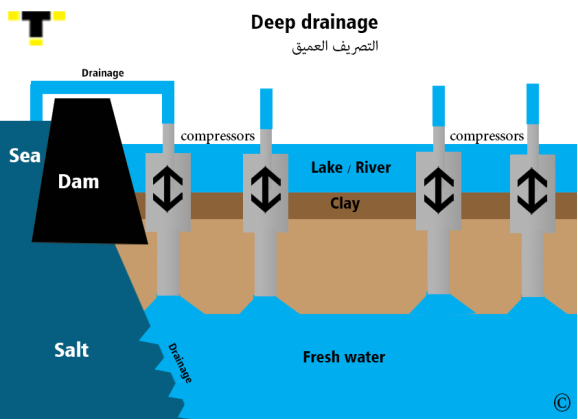
Innovative hydrostatic or dynamic compressors (capable of achieving high automatic flow rates up to 1000 m3/s and pressures up to 1000 bar) are distributed across various parts of lakes and other waterways and can be set to manage water level (especially during times of high water levels) where they continuously discharge water above this level (without consuming any electrical energy) in two directions: downwards (for groundwater charging and storage) or/and upwards (for surface discharge and drainage canals).
Option 2: The option of their future reclamation and conversion into polders may require (according to Tocnology3) equipping them with closed (fast) flow drainage stations and systems and large-scale open flow systems (APWS) to compensate for and/or maintain their role in drainage.
Strong-flow system (and T-drainage):
The concept of strong flow involves increasing the pressure and/or level of flow to achieve many goals, including:
- Transport it more quickly over longer distances.
- Easily discharge it into high-level seawater.
- Ability to perform water purification and filtration processes such as reverse osmosis (RO).
- Ability to be used for deep (groundwater) recharge and drainage.
- Ability to be used for generating clean and sustainable electricity.
- Ability to be used for defense purposes.
One of the proposed Tocnology3 systems for achieving strong flow is the use of the following drainage system, also known as the T-Drainage System:
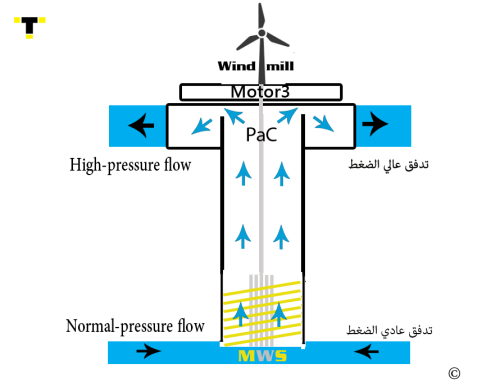
The vertical pump of MWS, powered by renewable energy sources such as wind or a motor3, efficiently lifts water to a top-mounted compressor called PaC (Pascal Compressor), which then increases the flow pressure to high levels, making it ready for its intended purpose.
Multi-purpose drainage systems can also be constructed. For example, if there is a constant flow is discharging into the sea, a strong T-drainage system can be built to achieve this easily, generates sustainable electricity, and serves defensive purposes simultaneously, as follows:
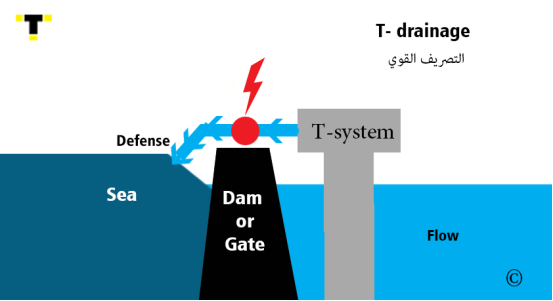
Defensive (and Offensive) Flow:
It is no longer limited to building defensive systems to protect against surrounding dangers. Tocnology3 goes further to create and innovate systems that go beyond defense to offense. As they say, "The best defense is a good offense," through new projects and concepts that include water gates and dams, as follows:
- Water Gates
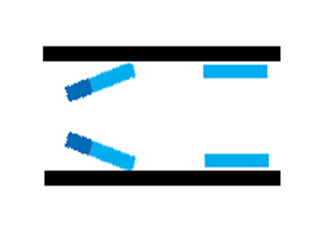
This is an innovative concept for parallel or angled water propulsion using innovative pumps or compressors, such as the modern screw Tocnology MWS, which can be deployed horizontally at various scales in shallow or deep waterways or gates to achieve directed flow that prevents intrusion by surface or deep saltwater. This ensures that waterways or gates remain operational without closure and unaffected by high sea levels. Examples of its applications include its integration with:
1- The world's smartest Maeslantkering gate: helping in keep it open.
2- The Afsluitdijk closure dam, the protector of the north: helping in ensure the continued operation of its gates, allowing water to flow normally (by gravity) from Lake IJsselmeer to the sea.
3- The Westerschelde open funnel: where surface or deep-water gates Technology (if needed) can be used as an option in harsh marine conditions, to support large existing side passive defenses, or to support freshwater flow at the expense of saltwater, with the advantage of allowing navigation to continue operating freely.
-Water dams

An innovative concept for a large-scale, low-cost defensive-offensive solution that can be deployed (in straight, concave, or convex structures) over long distances to counter maritime hazards such as storms in emergencies or manage sea levels in normal conditions. Its operating principle is based on Newton's Third Law (for every action, there is an equal and opposite reaction), whereby it harvests and absorbs dynamic marine energies such as waves, currents, storms, and other renewable energies such as wind, in addition to mechanical energies (innovative high-pressure, high-vacuum pumps) and redirects them as directed offensive energy (counter-reaction) to support and protect existing defenses or even manage (lower) sea levels on a large scale and over long distances.
Its applications include spatial deployment along the central shore (to protect the heart of Holland, The Randstad, and its precious water and financial resources), the northern shore (if needed), or the southern shore (to support and protect Delta Works).
Rotated flow system (flow3):
It is an innovative flow system (Flow3) that achieves highly efficient integrated management of the flow. In addition to managing water resources, it also manages other resources such as energy, the environment, and others. It is also a strong candidate to play a role in managing Dutch water resources with large flows and varying degrees of pollution, salinity, and intensive energy consumption.
Environmental flow system (safe flow):
This is what innovative technologies3 achieve by working in harmony with nature through their low or zero emissions and high energy efficiency, in addition to their innovative structure and systems. For example, pumps3 (including Modern Water Screw MWS) with a wide structure (where their diameters can exceed 5 meters) and a safe flow system (quiet and bladeless) can represent safe passages and ladders (elevators) for aquatic organisms such as fish, see Fish3.
Support flow:
Tocnology3, with its innovative tecs, could also play a complementary and supportive role in pioneering Dutch water management projects, including:
1- Giant pumping and drainage systems: and stations spread throughout the country. Tocnology3 suggests expanding their role in auto-drainage and T-drainage to increase efficiency and deeper to increase underground storage capacity, protect and renew it, get rid of old or new saline intrusions, and increase the Head pressure and Q flow (drainage) of groundwater, especially since the structure of the underground reservoir is multi-layered Aquifers with high porosity at the top up to 100 m and with low porosity at the bottom deeper than 100m makes it eligible to play this role.
2- Room for the River system: which aims to give rivers more space to flood safely, and with the integration of systems such as closed flow (FRS fast river system) or technologies such as auto-water compressors, it will increase efficiency and drainage (surface-deep) and greatly reduce risks.
3- Polder System: a system of reclaimed land from the sea or from rivers in the Netherlands (and often low-lying areas). In this system, the innovative Automatic Polder Water System (APWS), which we talked about previously, may play a role in its water management and protection from risks such as flooding, salinity, and drought.
4- The Bubble Barrier: an innovative Dutch system addresses two problems simultaneously: preventing plastic pollution and salt intrusion into freshwater, all without hindering shipping or harming fish. Its efficiency and effectiveness can be significantly enhanced by Tec3 innovative dynamic compressor pumping systems. Furthermore, its role is proposed and supported for expanding and using in solid waste and mining, as will be discussed later.
Natural vs artificial
|
Artificial |
Natural |
|
|
Small |
Big |
Size |
|
lower |
High |
Cost |
|
Lower |
High |
Maintenance |
|
Fast |
Slow |
Drainage |
Costs:
To calculate the cost of water sector energy consumption, as follows:
- Total daily water sector consumption: ~4,000,000 kilowatt-hours (Enough to cover the energy needs of about 450,000 to 500,000 Dutch homes per day).
- Share of drainage pumps (Gemalen) 35%: about 1,400,000 kilowatt-hours per day.
- Average price per kilo: about $0.25.
Total cost:4,000,000 kWh * 0.25 USD= 1,000,000 USD
Drainage cost: 1,400,000 kWh * 0.25 USD= 350,000 USD
The daily total cost = $1,000,000 (The annual cost = $360,000,000)
The daily cost of pumping and draining energy = $350,000 (The annual cost = $126,000,000)
Note 1: In the event of a severe rainstorm, the drainage cost may rise to exceed $1,000,000 per day due to the giant emergency pumps operating at full capacity.
Note 2: Adopting an auto-deep water management methodology will reduce the cost by approximately 50-90%.
Calcs:
The current deep drainage (DD) rate ranges between 2-5%. If we develop it (naturally-artificially) to have a deep drainage system (DDS) with a rate of 25%, which means, capable of deep drainage of a quarter of the total water flow of the Netherlands (which is estimated at about 100 billion cubic meters of water annually), then if the goal, for example, is to reclaim the huge underground basin by increasing the share of fresh water from about 40% to half 50% (to eliminate undesirable phenomena such as small and isolated water lenses or saline intrusions), then we need a deep flow of more than 200 billion cubic meters of fresh water. Therefore, the DDS system will need more than 8 years of work. But if we want to increase the share to 100%, then we need 1200 billion cubic meters of fresh water, and about 48 years of work of the DDS system.
Conclusion:
Freshwater (especially in the Dutch case) is the weapon and ammunition in the ongoing battle for survival and facing saltwater. Therefore, it must be managed and discharged wisely. Focusing on getting rid of it by discharging directly into the sea is perhaps of the practices that needs to be reviewed. Adopting GoDeeper® (natural-artificial) methodology as a new vision, game-changing technologies, and appropriate (applicable and scalable) solutions in managing water resources/risks (and consistent with the Dutch water management system, based on boldness, innovation, and long-term planning) may ultimately lead to an auto, safe, and sustainable management system that eliminates many undesirable problems such as flooding, pollution, drought, and saltwater intrusions, And to stand more firmly and at a lower cost in the current battle and in the face of great future challenges such as climate change (and rising sea levels).
"Ga dieper mee met de stroom "